'Boycott Florida' isn't so simple, experts say
July 27, 2013 -- Updated 1249 GMT (2049 HKT)
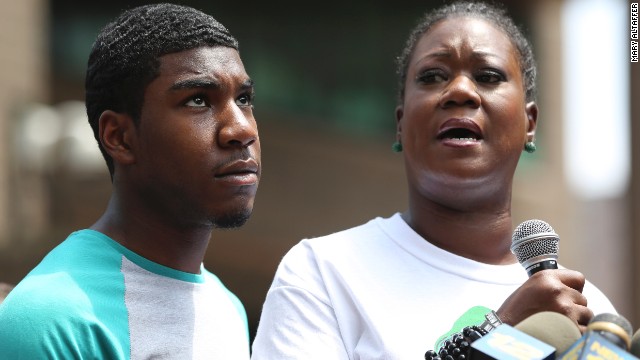
(CNN) -- Many angry Americans are urging a punishment on Florida in the killing of Trayvon Martin: a boycott.


Musician Stevie Wonder won't perform there.
Martin Luther King III is considering deploying the tactic -- often
used by his famous father in the civil rights era -- against Florida
products like orange juice. Social media activists advance boycott plans
even on the state's official tourism page on Facebook.
Their actions seek the
repeal of Florida's "stand your ground" self-defense law, which was at
the center of a national debate in the wake of Martin's shooting death.
George Zimmerman's lawyers didn't invoke Florida's "stand your ground"
law in court, but it was included in the instructions to the jury that
acquitted him.
But will a boycott work? And when are they effective?
'Stand your ground' laws up to states, not Obama or Congress
The win column is spotty
for boycotts against controversial state laws, experts say. The matter
becomes further complicated by the fact that more than 20 states -- not
just Florida -- have such a law.
"For boycott organizers,
it's more difficult with a state," said Daniel Diermeier, a professor at
Northwestern University's Kellogg School of Management.

"Let's say your goal is
to change a particular law," he continued. "If you think about a
political process, you could have multiple chambers and a governor. The
political process is much slower and messier than a corporate decision
process."
One example of success -- at least economically, one group says -- is the recent boycott of Arizona for its immigration laws.
Akin to the Florida
"stand your ground" law, the Arizona immigration law "triggered a
fierce, national public-opinion backlash against the state and led many
national organizations and opinion leaders to call for economic
boycotts," said a 2010 report by the left-leaning Center for American
Progress.
Arizona lost at least $141 million after groups canceled their conventions there, according to estimates in the 2010 study.
"This report provides a
clear window into the potentially catastrophic impacts of pursuing
harsh, state-based immigration policies," the center said.
But other analysts point out how Arizona didn't change its immigration laws, despite the boycott.
It took the U.S. Supreme
Court to do that, in a decision last year striking down key parts of
the state law that sought to deter illegal immigration.
"It didn't impact the
state in such a manner that people considered changing the rules and
regulations, so all of this was done with very little positive results,"
said Abraham Pizam, a tourism professor and dean of the hospitality
management college at the University of Central Florida in Orlando,
which is also home to Disney World.
But the center said the
boycott did send a warning: "Other states considering immigration
legislation should pause before rushing to adopt measures like (the
Arizona law) S.B. 1070 and understand the potentially disastrous
economic and fiscal consequences of such a decision."
In general, boycotts
have three functions: to cause economic damage, to keep a spotlight on
public issues and to achieve a stated objective, Diermeier says.
While boycotts can be effective in the first two aims, the third goal can be murky.
"Do they accomplish the
objective? There, the record is spotty," Diermeier said. "They are
driven by outrage and anger, but they (sometimes) don't have a clearly
specified objective."
The Occupy movement in
2011 had such results: "They never accomplished a specific objective. It
was more of a channel for outrage," he said.
Among the better-known
cases of boycotts producing major political change is in the apartheid
era of South Africa, when many nations imposed an economic and cultural
boycott so intense that the country became an international pariah.
The boycott lasted
several years. Finally, under the international pressure, South Africa
ended apartheid, the system of legalized racial segregation. That was
more than 20 years ago.
"Many said that
(boycott) had an effect, but it lasted a long time, and it was supported
by a large number of countries, and it was supported by the vast
population," Pizam said.
"That's a different
situation than we have now" with "stand your ground" laws, Pizam added.
"There are people in Florida -- I know some of my colleagues -- who feel
the 'stand your ground' law is the right thing to do in Florida, so you
don't have 100% support" for a boycott, he said.
In addition to needing widespread support, a boycott would have to offer consumers easy alternatives.
For example, can
Americans easily cancel their family vacation to Orlando's Disney World?
Can they easily find a substitute for their favorite Florida orange
juice brand, especially when growers say they had nothing to do with the
jury's acquittal of Zimmerman?
"For a boycott to be
successful, we have to ask people to do things against their economic
interests," said Maurice Schweitzer, a professor at the Wharton School
of Business. "People are going to visit Disney or not. They are going to
visit Grandma or not."
Boycotts require a
commitment, such as when the Rev. Martin Luther King Jr. led a
successful boycott against buses and other public transportation in
Montgomery, Alabama, in the 1950s as part of the civil rights movement,
experts said.
A clear and simple goal must be present, with "a protracted feeling of outrage," Pizam said.
Remember how Americans boycotted French wine after France declined to join a U.S.-led coalition to invade Iraq in 2003?
"The feelings that we
have today are not the feelings that we're going to have in six months,"
Pizam said. "Just as we were upset at France and might have chosen an
Italian wine over a French wine a dozen years ago, I think you would be
hard-pressed to find an American avoiding French wine."
Boycotts can backfire,
such as when the president of Chick-fil-A provoked a consumer boycott by
denouncing same-sex marriage and saying his fast-food chain backs the
traditional family unit.
Traditional family supporters, however, organized a counterboycott -- a "buycott" -- and even a "Chick-fil-A Appreciation Day."
"There were some groups that went and actually started frequenting Chick-fil-A more," Schweitzer noted.
Corporate boycotts can
yield more immediate results because CEOs can act faster than elected
lawmakers, but the activism requires key ingredients: Consumers must
care, customers must be able to easily shop elsewhere, issues must be
understandable, and the boycott needs mass attention, often enhanced by
speedy social media, Diermeier wrote in the Harvard Business Review last
year.
One successful effort
was Greenpeace's 1995 boycott of Shell -- a specific target -- which
reduced sales in Germany by 40%. The "McCruelty: I'm Hatin' It" campaign
by the People for the Ethical Treatment of Animals, however, has had
"limited impact" on McDonald's because the issues are "complex and not
intuitive," especially in comparison with the more easily grasped notion
of a fur boycott, Diermeier wrote.
The analysts were
pessimistic about a successful Florida boycott, even if Wonder is
calling upon fans to avoid doing business in Florida and any other state
with a "stand your ground" self-defense law.
King, the civil rights
scion, is also weighing a multistate boycott, such as against Georgia
peaches because that state also has a "stand your ground" law.
"These are things that my father considered in his era," King said.
But a Florida boycott
faces overwhelming odds because it lacks an easy target and uses
economic pressure to seek political change, experts say.
Moreover, the gambit may
even hurt African-Americans and other minorities because they often
work in the Sunshine State's vast tourism industry.
"Business will suffer
the least, and employees will suffer the most," said Pizam, the Florida
tourism professor. "It's good-intentioned people who don't realize the
unintended negative consequences that will hurt the ones they want to
help."
Added Schweitzer about a
Florida boycott: "It's ridiculous. It's an expression of frustration,
and I think that frustration is valid.
"But I don't think
there's sufficient groundswell to motivate a campaign that a boycott
would require," he continued. "For boycotts to be successful, people
have to have easy alternatives. Either you're going to visit Grandma, or
you're not. And there aren't easy alternatives."
---------------------------------------------------------------------------------------------------------------
Boat operator charged in H
Hudson River crash; engaged couple on board

July 28, 2013 -- Updated 0231 GMT (1031 HKT)
(CNN) -- The path that led Lindsey Stewart and Brian
Bond to decide to join their lives together was as measured and
deliberate as its end was abrupt.
The two had been friends
since they were children living in the suburbs north of New York City.
They went to the same church. More than three years ago, the
relationship turned romantic.
Next month, the
30-year-old human resources manager at an insurance company in Nyack,
and her 36-year-old beau were to marry at Good Shepherd Church in Pearl
River.
The reception was to be at Torne Valley Winery in Hillburn.
"She did all the plans herself," her stepfather, Walter Kosik, told CNN. "She had everything under control."
Actually, some things were out of her control.
On Friday night, Stewart
and Bond and four of their friends dined at a restaurant, then boarded a
21-foot Stingray power boat on the Hudson River for what was to have
been a nine-mile ride from the village of Piermont in Rockland County to
Tarrytown.
It was a clear, balmy night.
The short ride and the
couple's long-term plans collided fatally when the boat struck the side
of one of three barges that were lashed together at a construction site
near the Tappan Zee Bridge, 25 miles north of Manhattan.
The barges, which were
being used by a contractor who is building a new bridge, had been
anchored in the river since around April, Van Cura said.
Stewart was thrown from the boat, as was Mark Lennon, who was to have served as the couple's best man.
Despite suffering
serious head injuries, Bond called 911 from the boat Stewart's fiance,
Brian Bond, at 10:41 p.m., reporting the boat had struck an object south
of the bridge.
Rescuers poured in from around the area, but to no avail.
At 2:30 a.m. Saturday, the police showed up at the house belonging to Stewart's mother and stepfather.
"That's something -- a
nightmare -- I don't wish on any parent, to get that police coming over
your house waking you out of your sleep to tell you that an accident has
occurred," Kosik said.
A few hours later, a
body believed to be that of Stewart was discovered about an eighth of a
mile off the riverbank. The search for Lennon, which proved fruitless on
Saturday, was to resume Sunday morning, but officials held out little
hope that he would be found alive.
"We're always hopeful,
but obviously, at this hour, it's less and less likely that this would
be a rescue as opposed to a recovery," Robert Van Cura, undersheriff of
the Rockland County Sheriff's Office, told reporters.
The four who were not thrown from the boat suffered head injuries and were taken to area hospitals.
One of them, boat operator Jojo K. John, 35, was arrested.
"We have probable cause to believe that he operated the boat while intoxicated," said Van Cura.
John was arraigned at an
area hospital on one count of first-degree vehicular manslaughter and
three counts of second-degree vehicular assault, Van Cura said.
More charges are possible, he said.
Van Cura said that the operator was not the registered owner of the boat, which may have more than one owner.
Bond was hospitalized at
Westchester Medical Center, said Kosik, who visited him Saturday in the
hospital. "He was in no condition to talk."
A spokesman for the medical center said Bond was in fair condition.
"She's supposed to be married two weeks from today," said Carol Stewart about her daughter. "It just can't end like this."
An investigation has
begun. "The barge had some lights on it; whether or not it was properly
lighted is part of the investigation," Van Cura said.
"On a clear, moonlit
night, with the bridge lights on, you can see pretty well," said Tom
Sobolik in a telephone interview from aboard his sailboat near the
accident site.
The moon was last full on July 22.
But Craig and Celeste
Kmiecik said they were boating in the area on Friday night and that it
appeared dark. "There was a moon last night, but you really can't see
anything," said Craig Kmiecik.
"The barge was not lit up," said Celeste Kmiecik. "We saw that last night coming back to the marina."
